Landings in the UK
Mackerel and herring catches, known as pelagic fish, make up most of the volume of landings in the UK. The amount of fish landed into the UK did not change significantly in 2022 compared to the previous year.


Did you know?
Around 80% of the fish landed in the UK
is
exported.

Volume of landings into the UK
Top 5 species
1. Mackerel 91,886 (-2%)
2. Herring 48,783 (+20%)
3. Haddock 32,919 (+30%)

4. Scallops 28,416 (-5%)

5. Nephrops (Norway lobster)
28,234 (-11%)
Value of landings into the UK
Top 5 species
1. Mackerel £109m (+5%)
2. Nephrops (Norway lobster)
£105m (+16%)
3. Scallops £53m (+4%)

4. Crabs £49m (-6%)
5. Lobsters £47m (-8%)
Did you know?
Demersal and Pelagic relates to the zone of the sea or ocean fish
are
found.
Demersal fish live and feed near the bottom of seas and oceans known as the Demersal Zone.
Examples of Demersal
fish include cod, haddock, turbot and halibut.
Pelagic fish live and feed away from the bottom of seas and oceans known as the Pelagic
Zone.
Pelagic fish
contain more fish oil than demersal fish – sometimes up to 30%. Examples of pelagic fish include mackerel,
herring and tuna.
Performance of the UK fishing fleet
Our UK fishing fleet caught 618,759 tonnes of fish in 2022.
That could provide enough seafood to feed the population of Europe two portions of seafood a week.
Financially, average
prices of catch
increased, but so did
fuel and other fishing costs following the fuel price crisis of 2022.
This led to a lower operating profit for the fleet than the year before
Did you know? The UK fishing fleet always lands more
fish than the total amount of fish landed in the UK. This is mostly down to the pelagic fleet catching
large volumes
of herring and mackerel and landing it overseas for
global customers.

Total
turnover
£1,024m

Operating
profit
£222m

Full-time
equivalent job
6,557
Active
vessels
4,076
Total fish and shellfish caught by UK vessels:
618,759 tonnes £1,003m
Fishing fleet* around the UK
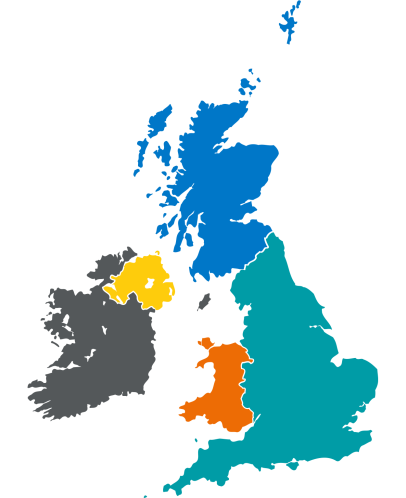
The English fleet is larger in size but the catching capacity (vessel tonnage) of the Scottish fleet is
double that of the English fleet. The high volume of catches of pelagic species by Scottish
vessels
generated more than double the turnover too.
UK vessels landed 23% value abroad
*UK vessels and operations in the UK and abroad
Data notes and sources
Landings
Data Source: Marine Management Organisation.
Reference: MMO monthly landings statistics
https://www.gov.uk/government/
collections/monthly-uk-seafisheries-statistics
Fleet economic performance
Data source: Seafish
Reference: Seafish Fleet Enquiry Tool
https://public.tableau.com/app/profile/
seafish/viz/FleetEnquiryTool/1Overview
Note that 2022 performance and landings data is provisional
Aquaculture production
Data Source: Centre for Environment Fisheries and Aquaculture (CEFAS)
Reference: Data supplied directly to Seafish
Trade (Imports and Exports)
Data Source: HMRC monthly data via Business Trade Statistics (BTS), processed by Seafish.
Reference: Seafish Trade and Tariff Tool
https://public.tableau.com/profile/seafish#!/
vizhome/SeafishTradeandTariffTool/
Overview
Note that 2022 trade data is provisional
Processing
Data source: Seafish
Reference: Seafish Processing Enquiry Tool
https://public.tableau.com/app/profile/
seafish/viz/ProcessingEnquiryTool/
2021Overview
Retail data
NielsenIQ ScanTrack data to 52 week ending 31/12/2022; Reference - Monthly Retail Report 52
week ending (w/e) data to 31.12.22; Link to report on MI Portal; Seafish.Org link to retail page and factsheets.
Foodservice data
Circana data to year end December 2022; Reference - 2022 Q4 NPD Data Sheet; Link to report on
MI Portal; Seafish.Org link to foodservice page and factsheets.